Tightly Held Houses Grow Faster
Why the number of previous owners matters more than you think. High churn isn’t ‘liquidity’, it’s usually a warning sign.
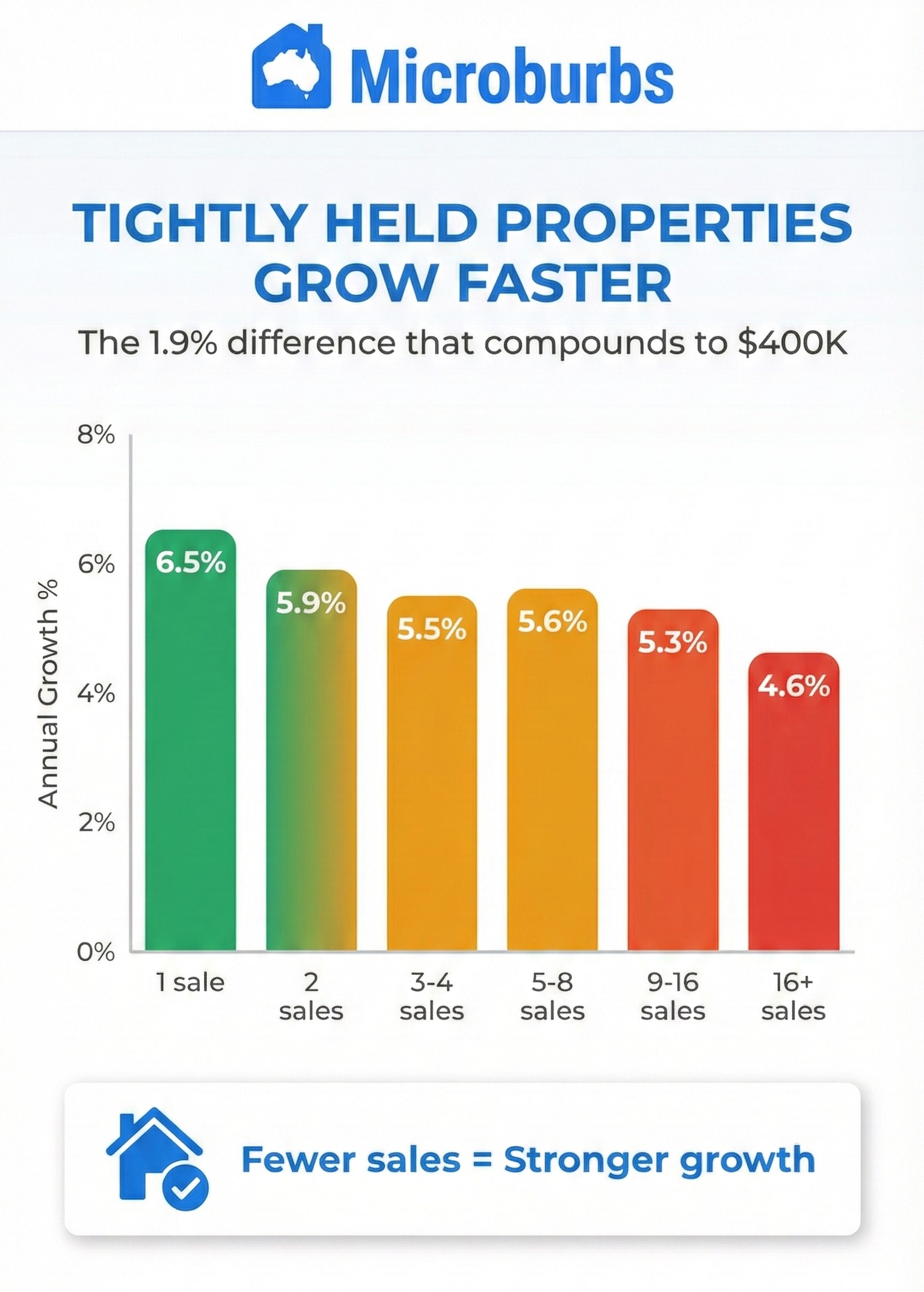
Key Finding: Properties that have sold only once experienced 6.5% annual growth, compared to just 4.6% for properties that have changed hands 16+ times. That's a 1.9 percentage point difference that compounds significantly over time.
The Pattern
One of the most persistent findings in our analysis of Australian property data is the relationship between turnover rate and capital growth. Put simply: houses that change hands less frequently tend to grow in value faster.
This isn't just a marginal effect. When we analysed hundreds of thousands of property transactions across Australia, we found a clear, monotonic relationship—every additional sale in a property's history correlates with lower annualised growth.
The Data
We grouped properties by the number of times they had been sold and calculated annualised growth rates for each group:
Why Does This Happen?
There are several plausible explanations for this phenomenon:
1. Quality Signal – Surfacing Hidden Problems
Properties that are frequently sold may have underlying issues—whether it's the house itself, the neighbours, the street, or the location. Happy owners don't sell. When a property keeps changing hands, it often signals that successive buyers discovered problems and moved on.
Crucially, turnover rate can surface problems that aren't otherwise captured in property data. The daily inconveniences of living somewhere—the morning sun that makes the bedroom unbearable in summer, the flight path that wasn't obvious during the inspection, the neighbour's dog that barks at 6am, the street that becomes a rat-run during school drop-off—these don't appear in any listing or data feed. But they show up in how long people stay.
In this sense, turnover rate is a powerful proxy metric. It aggregates the lived experience of previous owners into a single number. When multiple owners have each decided independently that a property isn't worth keeping, that's information you can't get any other way.
2. Pricing Psychology
When a property has limited sales history, buyers have fewer data points to anchor their valuation. With only one or two comparable sales in the last decade, purchasers often err on the side of paying a premium rather than risk losing a 'tightly held' home. This creates a self-reinforcing cycle where scarcity drives higher prices.
3. Owner Profile
Long-term owners tend to be owner-occupiers rather than investors. Our separate analysis shows that investment properties underperform owner-occupied homes by approximately 1.7% per year. Areas with high turnover often have higher investor concentrations, which correlates with weaker capital growth.
4. Transaction Costs as a Filter
Stamp duty, agent commissions, and moving costs mean that only buyers with strong conviction purchase property. When someone is willing to pay these costs to acquire a tightly held home, they're signalling genuine, long-term intent—which tends to support prices.
Practical Implications for Investors
1. Check sales history before buying. A property that has changed hands multiple times in recent years warrants extra scrutiny. Ask yourself: why are people selling?
2. Look for streets with low turnover. If only one or two properties on a street have sold in the past decade, that's often a positive signal about neighbourhood desirability.
3. Be cautious of 'hot' areas with high transaction volumes. Suburbs with lots of buying and selling activity may have investor-driven dynamics that suppress long-term growth.
4. Consider flipping strategy carefully. Our data suggests that buying tightly held properties and flipping them quickly can capture value—but holding loosely held properties long-term may disappoint.
Related Finding: Demographics and Neighbourhood Stability
Our threshold research uncovered a related and often overlooked factor: the demographic composition of a neighbourhood—specifically, the proportion of residents with overseas-born parents—shows a measurable correlation with future capital growth.
Why Does This Connect to Tightly Held?
The link is community demand and settlement patterns. Suburbs with moderate multicultural populations (7.6%–27.2%) tend to exhibit the characteristics of tightly held markets:
- Established community networks attract further settlement, creating sustained organic demand
- Owner-occupier dominated—families putting down roots, not investors cycling through
- Longer hold periods—migrant families who've established themselves in a community are often reluctant to move, reducing turnover
Below 7.6%, suburbs may lack the population diversity that drives broad-based demand. Above 27.2%, the effect reverses—potentially due to oversupply pressures in high-density areas, higher investor concentrations, or a preponderance of newer, high-turnover housing stock.
The sweet spot mirrors the tightly held dynamic: moderate, stable demand from people who intend to stay.
Practical Implications for Investors
- Check sales history before buying. A property that has changed hands multiple times in recent years warrants extra scrutiny. Ask yourself: why are people selling?
- Look for streets with low turnover. If only one or two properties on a street have sold in the past decade, that's often a positive signal about neighbourhood desirability.
- Be cautious of 'hot' areas with high transaction volumes. Suburbs with lots of buying and selling activity may have investor-driven dynamics that suppress long-term growth.
- Consider the demographic profile. Suburbs with moderate multicultural populations (7.6%–27.2% overseas-born parents) have historically delivered +1.48%/yr in additional growth—a signal of settled, community-driven demand.
- Consider flipping strategy carefully. Our data suggests that buying tightly held properties and flipping them quickly can capture value—but holding loosely held properties long-term may disappoint.
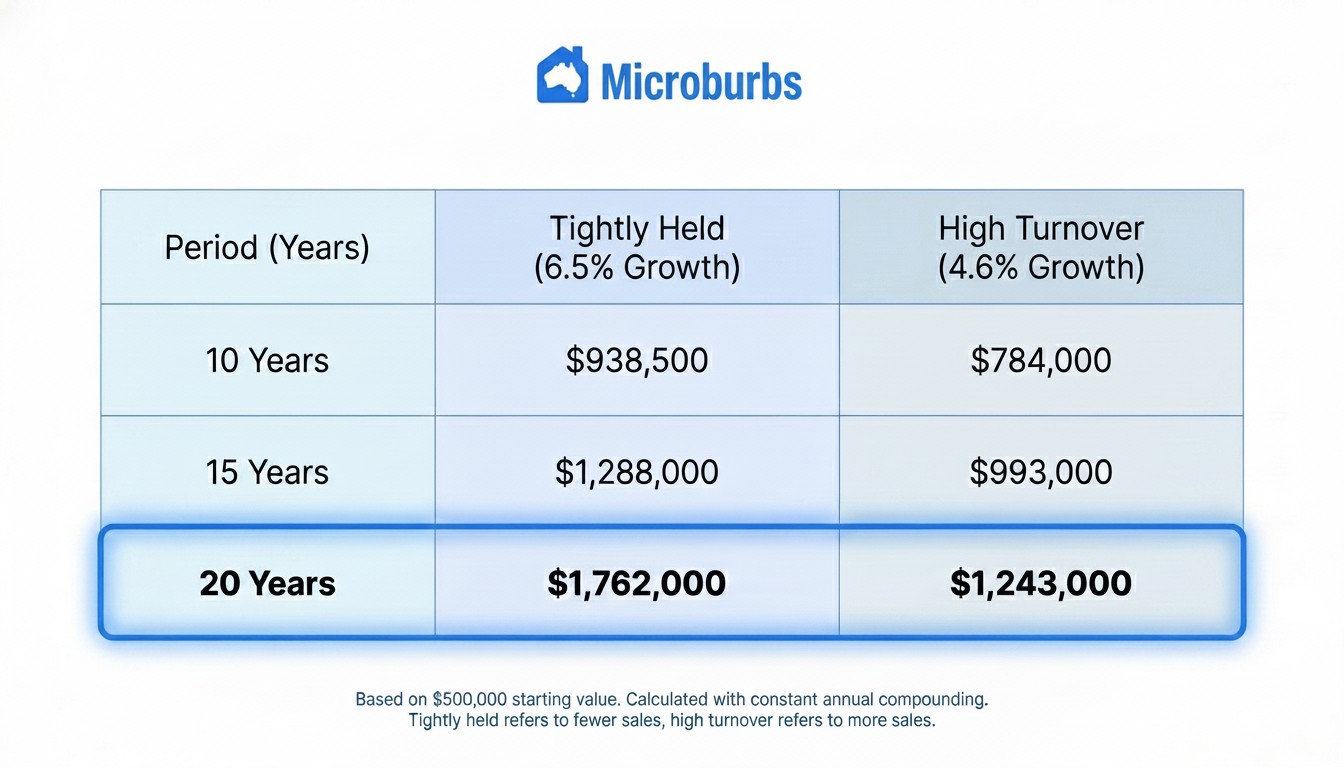
The Compounding Effect
A 1.9 percentage point difference might not sound dramatic, but it compounds significantly over typical investment horizons:
Important Caveats
• This is correlation, not necessarily causation. Tightly held properties may simply be in better locations or of higher quality to begin with.
• New developments will naturally have limited sales history—this doesn't automatically make them good investments.
• Some properties are tightly held because they're difficult to sell, not because owners love them.
• Local factors always matter more than broad statistical patterns.
The Bottom Line
When evaluating a property, sales history is a valuable—and often overlooked—data point. A home that has been held by the same family for decades, or a street where properties rarely come to market, may command a premium for good reason.
The best properties are the ones people don't want to leave.
About Microburbs: We provide street-level property intelligence to help Australian investors make data-driven decisions. Our analysis covers millions of transactions to surface insights that matter.